
Game, set, app: Oliver Preston on Seed, the tech platform revolutionising padel
By Lysanne Currie | 9 July 2026 | Sport
Oliver Preston made his career restructuring distressed businesses. Now he’s applying the same logic to one of the world’s fastest-growing sports
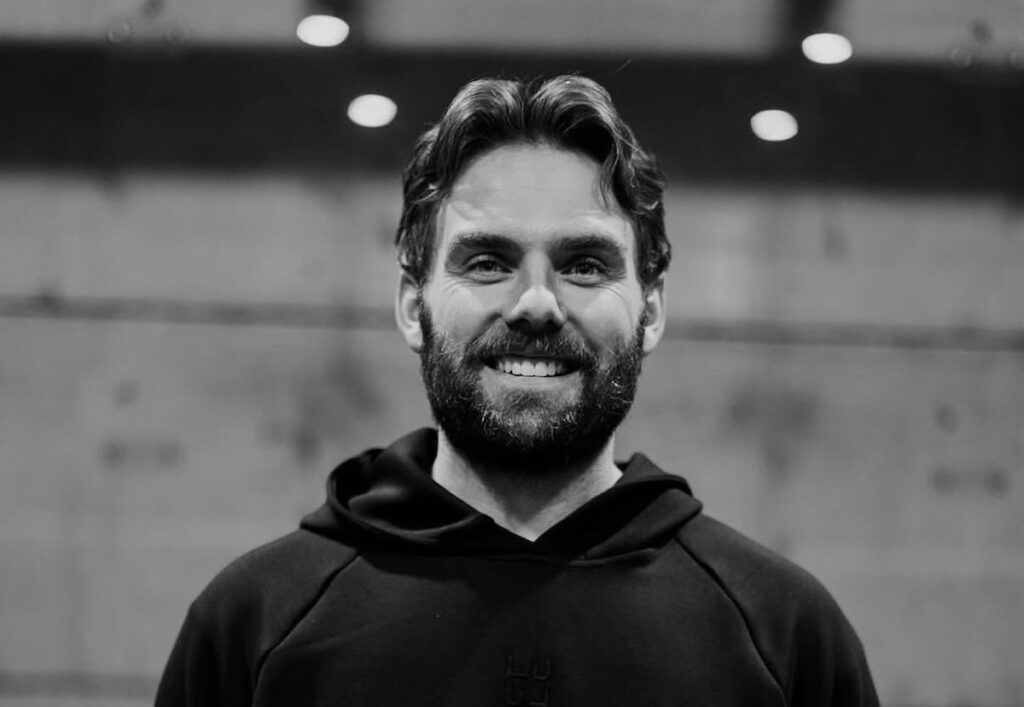 On paper, Oliver Preston doesn’t sound like an obvious founder of a sports tech platform. He comes from the world of finance – from private equity, debt markets, and corporate fixes – not software startups. And yet that’s precisely why Seed, the platform he’s created, makes sense. Years spent inside those high-pressure financial environments taught him how to spot weak spots and build back better; a mindset that now drives everything he’s trying to do with Seed – “and a certain racket sport”.
Padel is having a moment, no question. It’s gone from quirky novelty to global craze with around 30 million players worldwide, more than 130 countries taking part, and Britain’s numbers more than doubling last year to 860,000 adults and kids.
The appeal is obvious: combining elements of tennis and squash, it’s fast, social, easy to pick up. And it doesn’t punish beginners – or their bodies – quite as brutally as tennis.
In padel, though you might be a high or intermediate player, you can still end up playing with a beginner – “and everyone will still have a decent set of rallies and enjoy the experience,” as Preston says.
Part of the appeal, he jokes, is practical. “You don’t have to spend loads of time fetching balls because it’s contained within the glass.” And while he was a keen tennis player growing up, “it was too depressing to know what my ceiling was. Whereas with padel, I don’t know what my ceiling is. It feels fresh.”
It’s also, as he spotted early on, a sport whose tech infrastructure hasn’t caught up with its ambition. And for the man who was “waiting my whole life to invent something,” that was about to change. But we’ll get to that.  FINDING OPPORTUNITY
Preston was raised in Rawtenstall, in Lancashire. His father was a solicitor who worked long hours, while his mother went back to university aged 40 to retrain – the first in her family to go, having left school at 17.
“She studied to be a podiatrist, which I always found odd, because she has a deep loathing of feet,” he says. “She would probably have been better suited to biomechanics or gait analysis than corn treatment.”
Though he studied business economics at university, he didn’t yet have a vocation. That changed after a LinkedIn message drew him into commercial real estate, then private equity. Before, with great timing, he arrived slap-bang in the aftermath of the 2008 financial crash – and a world of debt.
The experience proved formative: it gave him a crash-course in how businesses succeed and fail – and a working knowledge of how to diagnose trouble quickly. “It absolutely sets you up for entrepreneurialism, because you can see where things go wrong,” he says. It also taught him resilience and preparation. He describes presenting deals to senior executives, Dragon’s Den-style – “but our dragons were much more aggressive”.
After a stint in Northern Ireland in his early twenties, he came back to London to join the world of real estate, then the affordable housing business. Before making a discovery that would change his life again. BALL PARK
Preston stumbled across padel while visiting a club in Welwyn Garden City. “I thought, ‘Oh, let’s just give it a go.’ And I loved it!’”
Soon he was playing three or four times a week. But he was also beginning to notice deeper structural problems within the sport’s fast-growing ecosystem. Much of the market, he says, remains fragmented and technologically underdeveloped.
Clubs, players and communities all exist in disconnected communities – with much of the actual social interaction happening chaotically through WhatsApp groups. “I must have 100 WhatsApp groups from all the different places I’ve played,” he says. Seed is designed to change that. GLOBAL VISION
At its core, Seed (now live in app stores) is a booking app – but Preston sees it as far more than just a booking platform. “We want is your club to be powered by Seed,” he says. “We want to establish an ongoing relationship between us, the padel club, and the community – all in one closed ecosystem.” A platform with “Social pods” where people can meet, compete, train and belong.
The platform also incorporates player rankings, video uploads, virtual coaching, and AI-powered match analysis. Preston is particularly animated about refining the ranking system, arguing that most current models are too simplistic. “If we lose 7-5, 7-6 to two elite players,” he says, “that’s a great loss. We shouldn’t be crushed for that.”
He also wants to help coaches monetise their expertise better. “I want to design a system where they can 10x their income,” he says, “and do that in all the downtime they may have – in hotels, at the airport, at the tournament itself.” One key early backer is Nikhil Mahindra, a well-known figure in the sport’s UK ecosystem. “We will be the exclusive operator of his clubs in the UK.”
And while that’s a good start, he’s also thinking internationally. “We’re not just targeting the UK. This is a global business. If the opportunity arose to go to the US tomorrow, we’d go to the US tomorrow. We want to go to the UAE. We want to go to Asia. I want to have a seat at that padel table. I want our grassroots padel to be up there with the Spanish and the Argentinians.”
India, in particular, excites him. “There’s 1.4 or 1.6 billion people… it’s exciting for us to take it to new markets.”
Rather than assembling a small group of like-minded startup operators, he’s deliberately sought out people with different experiences and skill sets: finance specialists, operations experts, marketers and social media strategists. “In order to reflect the needs of the community, you need to have a team that reflects different backgrounds and mindsets,” he says.
Coming into startup is humbling, he says. “I’m suddenly on the other side of the coin. What I’ve learned in the last eight months could have taken me 20 years in a normal job.”
“I love this sport,” he says simply. “This is just my way of putting my skills into something I’m passionate about.” I’d put the waiting all my life to build something here instead.